Wednesday, January 25, 2012

Tuna Balls


I'm standing on the beach at Nehalem Bay State Park.  The ocean is dark grey and the wind coming over the water is cold.  The clouds are heavy and low; rain could come at any time.  This is what the Oregon coast is like most of the year.  It is not a soft, warm place for beach towels, bikinis, palm trees and coconut scented sunscreen.  It is a hard cold place where ancient volcanic flows meet icy currents from northern places.  The ocean is always dark and never warm.

Beach grass at Nehalem Bay State Park, looking toward Nehalem Bay.
We leave the beach and are heading back to Portland.  After spending a weekend renting  a house with some friends, I appreciated the break from routing but are looking forward to getting back to that routine with the baby.  The weeks upcoming responsibilities have already started pulling our thoughts back to home.  My wife and I are discussing the logistics for the next five days.  Our minds have left the beach, and it's time for our bodies to follow.

But the ocean is there, next to us, undeniable.  And I know that under the impenetrable surface lives a bounty of creatures.  These creatures are my connection to this place. The water is too cold to swim in.  The  cliffs are too steep to climb.  But the seafood is there to be savored.

We stop in Cannon Beach to get lunch on the way home.  The town is cedar shingles and narrow streets.  Now is the off-season and the day is rainy.  There are no lines; parking is easy. Surprisingly, good seafood restaurants are hard to find on the Oregon coast.  A generally slow economy combined with heavy dependence on tourism mean many places don't last a whole year.  The ones that do survive are generally low priced and moderate quality.  The harvest of the sea is captured and distributed to other places with stronger economies and stronger demand.

We stop at Ecola Seafood for lunch.  To our surprise we find a menu full of delicious ideas and a deli case stocked with fish and shellfish of all kinds--whole crab, salmon fillets, halibut steaks, shrimp cocktail, oysters.  Stacked in front of the case is something I'd never seen before--locally caught Oregon tuna in cans.

Fish Balls


In The Essential Mediterranean, Nancy Harmon Jenkins says the fish balls recipe comes from a little Sicilian fishing port of Porticello and that Franco Crivello serves them like tiny meat balls, rolled no bigger than marbles, as an appetizer.  The recipe is simple--make meat balls out of tuna and serve them with red sauce.  In her recipe she uses tuna steaks, then grinds them like ground meat.  Egg and bread crumbs hold things together just like a real meatball.  But I don't have tuna steaks, and I don't have time to drive across town to Flying Fish Co. to get responsibly caught local tuna.  Then I remember the cans.

Canned tuna, while probably not as good as fresh tuna, would probably work just fine in a pinch.  Luckily, I find some at New Season. Whole sections of tuna in a can.  7 oz of loin steak for $7.   Expensive.  This is the sames as $17 per pound of fish.  The pricing is not competitive, especially when Starkist is on the self below at a fraction of the cost.  But it is the only option for line-caught, local tuna.  And it is only half a mile from my house.  It will have to do.

Franco Crivello's Fish Balls
The recipe is very simple, basically make little meat balls out of fish.  If serving as an appetizer, make them marble sized.  If serving as a main dish, make them ping-pong ball size.  Make sure to add enough egg to get them to hold together.  I had to add an extra half an egg.

Oregon responsibly caught canned tuna
Grated Romano cheese
Mint
Italian parsley
Roast pine nuts
Black Currant
bread crumbs
egg

Mix everything together to your liking and form into balls.  Saute the balls in vegetable oil until they are brown and the egg has set.

For the sauce, make a simple red sauce.  I don't like red sauce very much so mine is chunkier than they call for in the recipe.

Can of tomatoes (crushed or diced depending on your texture preferences)
Onion
Garlic
White wine
Pinch of sugar
Spices

Saute the onions and garlic until soft, reduce the white wine, add tomatoes and spices.  Done.

How you serve this is up to you. I put it over rice for lack of imagination.  Overall the recipe is good. I would add more spices to the fish balls next time, more salt at least.  I left out the currants because I didn't have any and the pine nuts didn't really add much for me so they could stay out next time too. More cheese might be nice.  And the sauce needs more complexity.  But different and healthier than beef meat balls.  A fun thing to experiment with.


Sunday, December 11, 2011

Oregon Oysters are Delicious


A few years ago I learned about Oregon oysters and decided that I must learn to eat oysters.  I'd never had an oyster before. Although I really like clams, I avoid mussels because I don't like a big gush of mushy guts in my mouth when I'm eating.  Remember Tidal Wave Bubble gum?  That juicy center?  Disgusting. No thank you.

But if you are going to eat local, then a part of that is eating what grows well here, not just what you can get to grow here.  Acceptance, not imposition.

Oysters grow well in Oregon (and the PNW in general), so I tried to eat oysters.  Tried is the main word, because whatever I did was absolutely disgusting.  I tried frying them.  I tried breading them.  I tried raw.  And then I was done.  Oysters were something that I caulked up to a long term objective and an acquired taste--something I'd have to work at over time and eventually learn to tolerate.  But at the time, all I could do was gag.

Fast forward a couple years.  The desire to learn to eat oysters is still there, and I have not made any progress. Then I find a place on N. Williams called Eat, An Oyster Bar.  The only reason I went into this place is because I heart Cajun food.  And with oysters so close, how could I not try them again.  This time different.  The server even offered to give me a couple for free just to give it a shot.

So I did.

I ordered their Oysters Rockefeller.  Baked oysters with creamed spinach and cheese melted over the top.  Browned under the broiler.  My life changed.  They were delicious.  The oysters were petite.  The spinach was mild and the cheese just sharp enough and browned enough to bring texture and substance.  It was a revelation.  Finally. Finally. Finally, after several years of hopes and disappointment I'd found the key to a truly local treasure.

Then the server brought me a couple raw oysters.  The smallest Tillamook Sweets they had.  On the house.  Just to try.

With great trepidation I poured one into my mouth and braced for the disgusting gush of shellfish mush I'd experienced with dread so many times before.  But this time was different.  The oyster was soft, but not an exploding shit bomb of guts in my mouth.  It was briny, and sweet.  It was something I did not need to fear.  In fact, I wanted some more of them. They were delicious, and I was amazed.

All of this is a big lead up to the actual point of this blog post, which is that I am making oysters as an appetizer for this year's solstice dinner. Normally, for the appetizer, I put together a charcuterie and fromage plate.  But this year I'm trying to increase the amount of seafood in my diet.  Plus solstice dinner always has a local focus.  Plus I have finally found the path to the mysterious Oregon oyster, and it is delicious.

So this weekend I tested some recipes.  Next Saturday (6 days away! Yikes!) we will be doing solstice dinner, and I need to know if the oysters will work.  After reading far too many recipes and opinions, I narrowed it down to two finalists.  Here they are.

Oysters Rockefeller
Based on a recipe from The Best of Gourmet.  I've written about this splendid cookbook before and I'll do it again here.  Here is my version of the recipe in a nutshell:

  • Saute spinach, parsley, watercress, and scallions in butter. Chill.
  • Shuck your oysters,then set in salt.
  • Sprinkle bacon over the top of the oysters.
  • Put some of the spinach mix over the top, sprinkle shredded  and bake.

Now, I changed their recipe a bit because I didn't use Pernod and bread crumbs in the spinach mix.  Instead I kept it to greens and then added a layer of Parmesan over the top. This is how Eat does it, and that's good enough for me.  It was good.  And very attractive.  But next time I think I'll add some cream to the greens.


Baked Oysters with Leaks and White Wine Cream Sauce
Based on a recipe from Fish and Shellfish by James Peterson.  James Peterson just writes the best cook books.  This was a much more mild recipe than the Rockefeller.  It was luxurious and buttery.  It was delicious.

Saute fine julienne leaks in butter.
Shuck your oysters.
Put the leaks in the shells, then oysters on top.
Spoon the white wine and cream reduction over the top.
Bake and then broil to finish.

I left out all the details of Mr. Peterson's instructions on how to cook the oysters.  There were a few steps involved.

These were very tasty. Rich and buttery.  Not as picturesque as the Rockefeller oysters though.

Not sure what way I'll go for Solstice dinner next weekend but its outstanding to finally be able to do oysters.

By the way, Eat also sells oysters direct. If you are looking for a good place to get local, sustainably farmed Oregon oysters, stop by Eat and see what they have.


Friday, November 25, 2011

Thanks-sharing

No turkey.
No cranberries.
No candied yams.
No green bean casserole.
No cornbread.
No pumpkin pie.

What we did have was one outstanding dinner.  We broke from tradition and made a new meal that was a welcome relief.

This year it was a conglomeration of the best flavors we could come up with.  Instead of sticking to the Thanksgiving script, we decided to make this food holiday about the food that we love rather than the food we are supposed to eat.  Each person brought something different; each person shared a little of themselves in the process.  They were small gifts to each of us, from each of us, enjoyed together.

There were, of course, a lot of meats.  Jamie called it a "meat-fest" and it pretty much was.  Dave laid out an amazing collection of charcuterie and cheeses as an appetizer.  Delicious cured salamis--thin and fat--from Olympic Provisions and imported cheeses from New Seasons--soft and hard--one of which was the best blue cheese I think I've ever eaten.  By the end of the night, I realized that in the hurley-burley of getting dinner ready, we did not spend enough time with this part of the meal.

When dinner did get on the table, it looked like a winter feast of foods.  I brought a sirloin tip roast. Dave brought a full king salmon fillet topped with pesto and laid on a bed of parsley. Tiffany brought her infamous champagne mushroom risotto as well as yams with yogurt.  Jamie provided the beet salad.  I made chard packages filled with sausage stuffing.  There was fruit salad.  There was a lot of wine.

Desert was no different.  Pumpkin pie is wonderful, but custards are more wonderful.  So, pumpkin creme carmels it was.  Pecan pie also showed up, as well as a beautiful apple pie.

Sitting around a table of food made by people who are sharing from themselves, and enjoying that experience with those same people has to be one of the great experiences of life.  We do several big meals a year--birthdays, holidays, etc.--but none is a holiday really devoted to breaking bread together the way Thanksgiving is.  It's a unique time.  It's a wonderful time.  Thank you to all my friends, for sharing.

In the interest of continuing the sharing, here are the recipes for a couple things:

Packing not Stuffing
Stuffing is good stuff.  I actually wish we ate more of it the rest of the year instead of reserving it mainly for holiday times.  With no turkey to stuff, I had to come up with something different.  This worked perfect.

Chard Packages Filled with Sausage Stuffing
Chopping Leaks
This is a cosmetic variation on the recipe from The Best of Gourmet, 20th anniversary edition.  The original calls for the chard leaves to be drawn up into a "purse" shape.  However, I found this impossible to do.  What was much easier--just fold the chard leaf over the stuffing and use the leak strips to tie it closed.

The flavors of the stuffing are simple and down to earth.  The bread is a nice medium for the salty, sage-y sausage and the earthiness of the only 2 vegetables.  Add salt and pepper and it is a nice uncomplicated stuffing.

  • Pork breakfast sausage
  • Dried bread cubes then soaked in milk
  • Red chard stems and leaks chopped and sauteed in the sausage fat.
  • Mix together and use egg (to bind)

For the packages use blanched chard leaves.  Plop a half a cup of stuffing in the middle and fold the leaf over.  Use strips of leak to tie it closed.  Bake with a little bit of chickstock to keep them from drying out.

WWROD (What Would Richard Olney Do)
I made a sirloin tip roast, but I knew it would need something to help it. There was a good chance I would mess up the roast (it did come out a little over cooked) and a good sauce can help bring almost anything back to life.  But what kind of sauce?  In these moments of culinary confusion, I frequently turn to The French Menu Cookbook by Richard Olney.  Once again, i found what I needed to find.  As an accompaniment to a formal autumn dinner, he puts Poivrade Sauce with a leg of venison roast.   But does it only go with game?  I checked in with my Larousse Gastronomique and found that no, Poivrade Sauce goes with most red meats but as some well known variations for game meats.

Poivrade Sauce
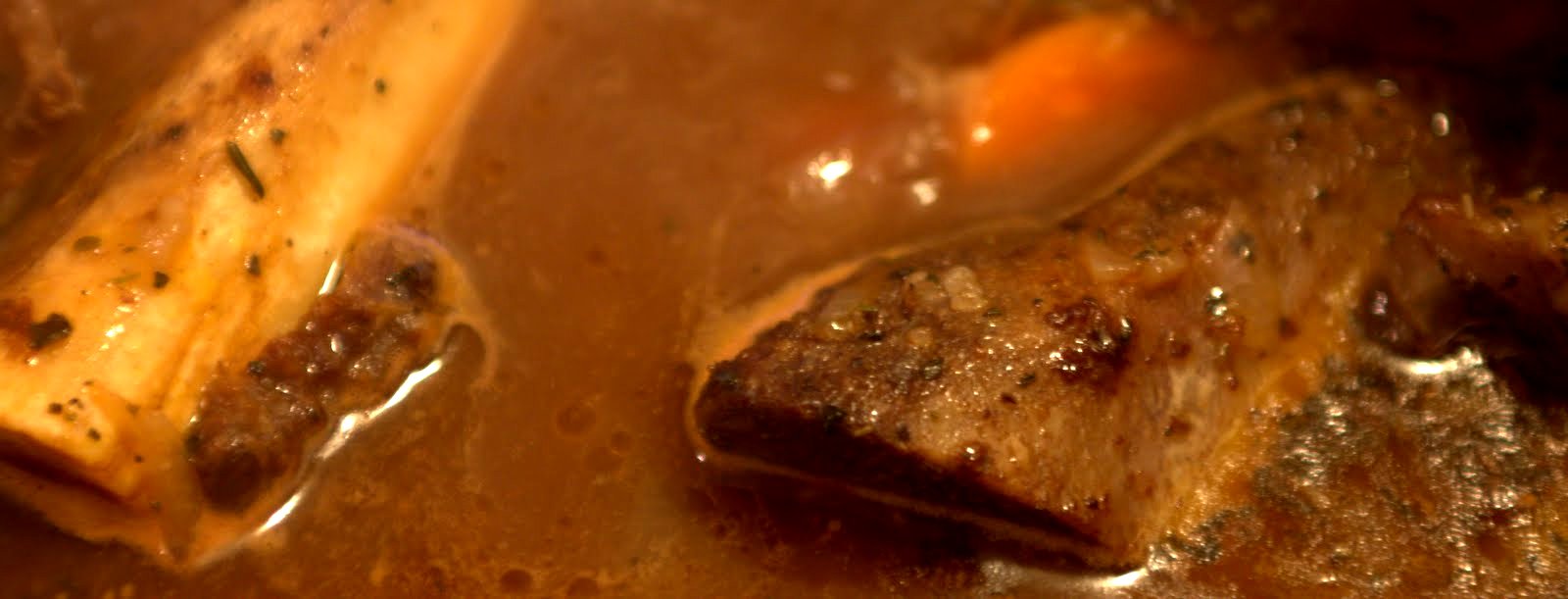
One thing to know about Poivrade Sauce, is that it is an old school (1700's) french meat sauce. What that means is the flavor profile will be more vinegary.  It also means you will be able to find 100 variations of this sauce because everyone does it differently.  Given those circumstances, you can really bend the flavors of this sauce to be whatever suits you.  Poivrade sauce is in the general family of sauces that use black pepper as a main flavor. I stayed pretty close to Olney's formula.

  • Carrots and onions and soup bones all sweaty and browned.
  • Flour roux for thickening.
  • Wine vinegar to deglaze (and some white wine)
  • Beef stock, tomatoe juice, herbs and juniper berries simmered for a few hours and reduced.
  • Add crushed black peppercorns at the end.
  • Add some butter to make it shine.

I also used more flour at the end to thicken it up like a gravy.

Pumpkin in a Cup
Pumpkin pie is delicious, not for the pie, but for the pumpkin.  Custard is delicious, for every reason.  What better time of the year to get two great tastes that taste great together?  I checked in with my buddy Alfred Portale.  In 12 Seasons of Cooking he has a nice recipe for Pumpkin Creme Brulee.  However, I had just eaten creme brulee a couple weeks ago.  So, it had to be creme caramel instead.

Pumpkin Creme Caramels
Of course, for the definitive recipe for custard anything, I have to check in with my other buddy, James Peterson.  In chapter 46 of Glorious French Food, he gives the best overview of each kind of custard and how to make them I have ever read.  Basically one egg will set 2/3 cup of milk.  After that come the variations, and there are a ton of them.  I used his orange creme caramel as the starting place and infused pumpkin flavors instead.  

  • whole milk infused with pumpkin puree, cinnamon, nutmeg, and sugar
  • whole eggs
  • more sugar melted to make the caramel sauce

Epilogue
Here are a few random pictures from the night.